Workforce structural changes have affected manufacturing in dramatic ways. In a post-pandemic world, manufacturers must consider the life cycle of every component, particularly when engaged in lights-out manufacturing practices. This is particularly true for motion systems. These tips will help design engineers understand the benefits of vee guide wheels and tracks that can help decrease their cost of ownership over time.
1) Make sure real-world performance has been tested properly.
During the design process for a linear motion application, it is wise to acquire a true cost-benefit analysis of every viable option. Testing procedures, with similar loading and duty cycle conditions, should allow for comparisons between general published life values and actual product performance. Some products may tout good performance in theory, but fall short of these theoretical values when put to the test. The right design choice will not only accelerate the development timeline but also trim expenses for the end user over the course of the machine's life.
2) Keep in mind long-term rather than short-term value.
Total cost of ownership requires that engineers consider more than just the cost of components and the engineering time to make those decisions. By looking longer term, engineers must think about installation and break-in requirements, load capacity and wear, and maintenance needs. Also, overall performance must dovetail with reliability throughout the lifetime of the application. Remember that machine repair and failure translate into downtime and unexpected costs.
3) Know how using the proper vee guide can affect track wear.
Tracks show wear over repeated cycles. This wear profile should be considered along with vee guide choice. The more the track material wears down, the greater the distance between the wheel mounting point and track mounting point decreases, which lowers precision over time.
Evaluate which product produces the shortest break-in period as well as the slowest wear rate. These features will make for a smoother motion and longer service life for the machine. Check suppliers’ test results to make a value-focused decision.
4) Look for linear motion systems that can be adjusted to extend life.
Some linear motion systems use guide wheels that can be adjusted closer to the track to take out space caused by material wear over time. Adjustment keeps the guides running smoothly and precisely. It also means that components can run longer without having to be replaced entirely.
5) Evaluate the environment in which the guide system will be operating.
If the motion system will be operating in a harsh environment where dust and debris are present, consider using vee guide technology that provides self-cleaning action while running. Additionally, a track lubricator assembly can easily be added to a guide wheel and track motion system. The assembly wipes debris from the linear track and continuously applies lubrication oil. Lubrication can increase the service life of the guide wheel motion components as well as reduce noise, decrease rolling friction, and inhibit corrosion.
6) Understand how material durability and wear properties can affect employee safety.
Guidance systems with lower-quality construction can fail catastrophically under load, expelling bearings and metal shards. This response can not only put employees in harm’s way but may also damage other machine components and/or contaminate material the machine is responsible for processing. If a system is ever run to failure or overloaded, it is preferable for the guide bearing to remain contained. The DualVee product line is designed to protect both life and property by remaining contained on the off chance that the bearings fail.
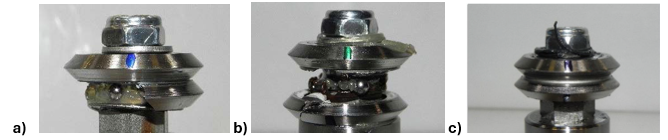
➔ Failure Comparison: In photos a and b, imitation products experience catastrophic failure that allows shards of metal and loose ball bearings to fly or drop from the vee guide; in photo c, the DualVee guide is contained during failure.
7) Be sure the supplier/partner offers high-quality support services throughout the design process.
Always consider what support is available from the manufacturer or supplier. The right partner will help to accelerate development time as well as future manufacturing efforts. The wrong motion system can cause early failure, which would cost much more than expected during the design cycle.
This technical white paper presents the results from extensive testing that quantifies the superior performance and reliability of Bishop-Wisecarver’s DualVee Motion Technology®.